

New Materials for Kitchen Facades and Countertops 2025–2026: What's Durable and Eco-Friendly
The kitchen materials industry is experiencing an important moment today: technology has finally caught up with expectations, and the eco-friendly trend has stopped being a marketing slogan. Customers increasingly begin a project not with discussions of color or shape, but with questions – what's safer, what will last longer. And here comes a new generation of materials – from biocomposites to nanoceramics. They are forming an entirely new approach to kitchen design – as a system designed not for years, but for decades.
Biopanels: A Quiet Revolution
One of the important discoveries of the past two years – biopolymer panels made from lignin and recycled fibers. Lignin is a natural polymer that makes up to 30% of any wood and was traditionally considered a waste product of pulp and paper production. It is becoming the binder of a new generation of building materials – free from formaldehyde and toxic resins.
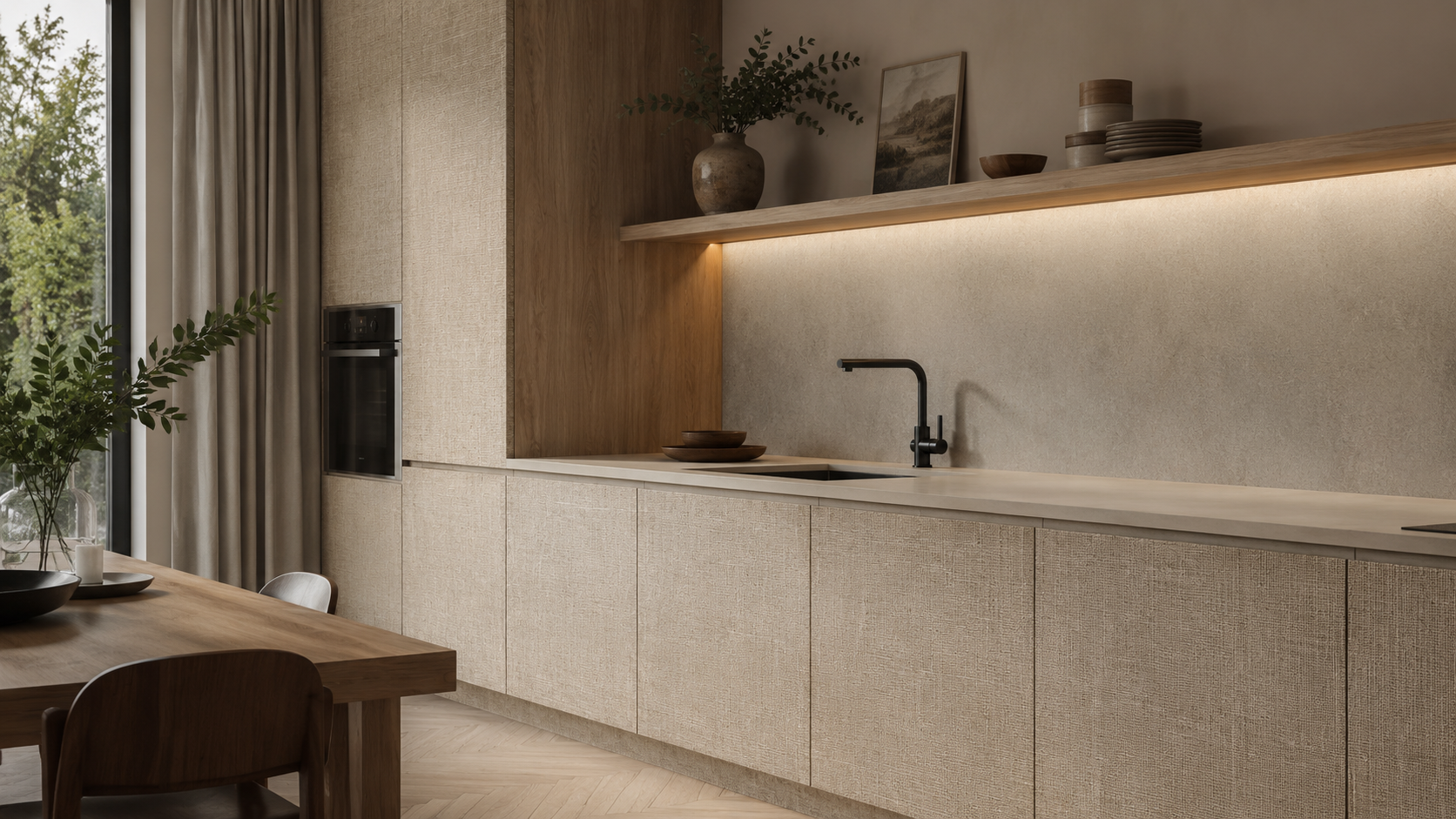
Biopanels with natural fibers – flax, hemp, bamboo, reed – are denser than conventional MDF, yet lighter, stronger, and environmentally cleaner. Facades based on them maintain perfect geometry, provide exceptional line clarity, and accept any finishes: thin veneer, matte lacquer, micrograin ceramics. Thanks to their stability, they work well where temperature and humidity constantly change – in the kitchen work area.
Sintered Stone: An Engineering Marvel for Countertops
If we're talking about what radically changed the countertop market – it's sintered stone. The technology seems simple at first glance: natural minerals are subjected to extreme temperatures and pressure – just as if they were deep in the earth's crust for thousands of years, but much faster. No resins, no polymers – just feldspar, quartz, oxides. The result is a monolithic slab with zero porosity that doesn't need to be sealed. It withstands a red-hot frying pan without a trivet, doesn't fade in the sun, and doesn't react to acids.
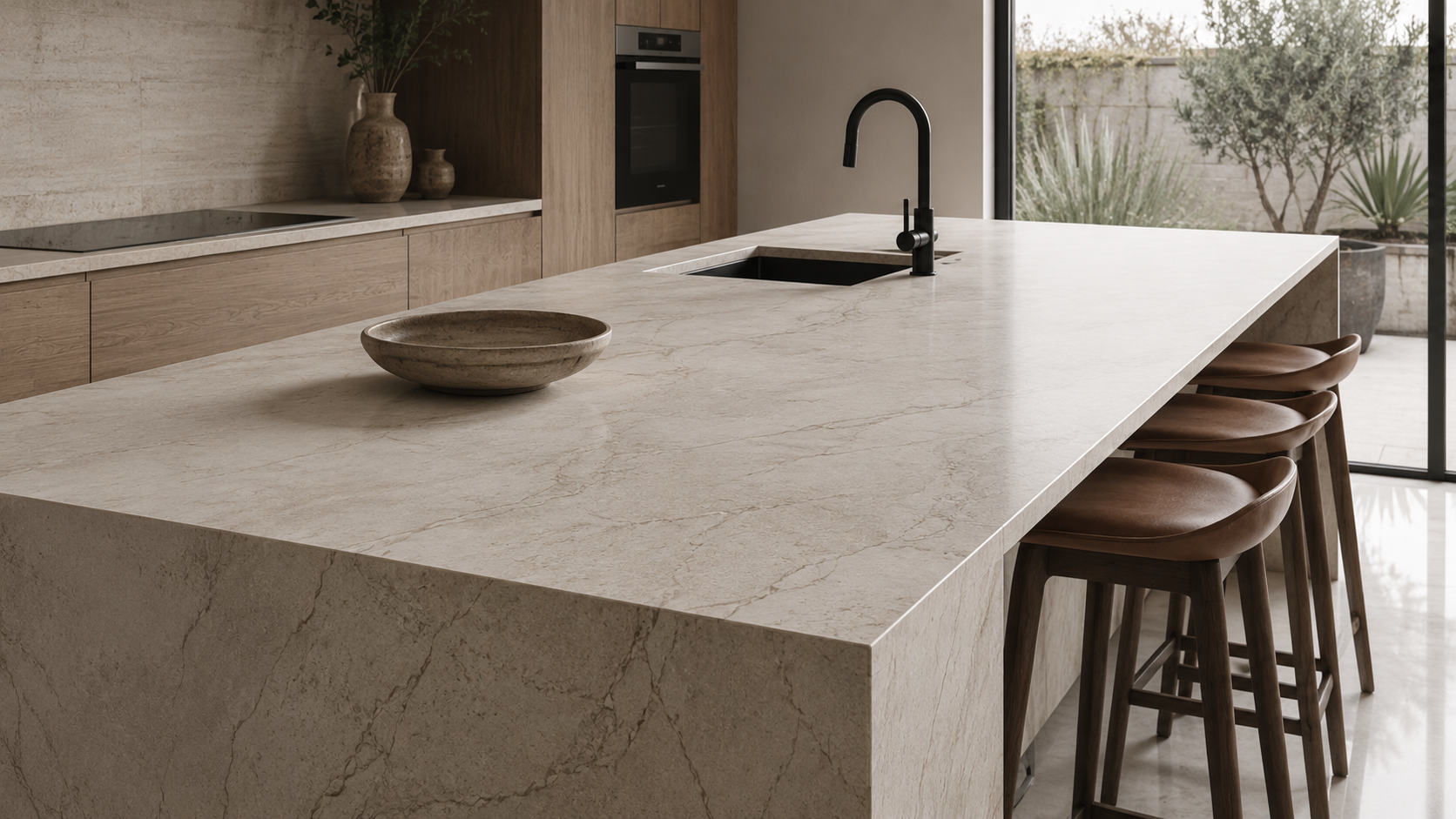
A truly modern interior without constant maintenance – that's exactly what sintered stone promises. Ultra-thin slabs from 3 mm allow you to create weightless islands and waterfall edges, which until recently existed only in beautiful renderings. New design innovations in this category are stunning: textures imitate limestone, travertine, concrete, and aged wood with an accuracy that was only a dream not long ago.
Nanoceramics: Thin, Yet Unbreakable
Nanoceramics – the next evolutionary step of traditional porcelain stoneware. Ultra-compact panels, reinforced with silicon dioxide or zirconia nanoparticles, demonstrate an order of magnitude greater resistance to mechanical stress than standard tile. Knives and dyes simply leave no marks on it.
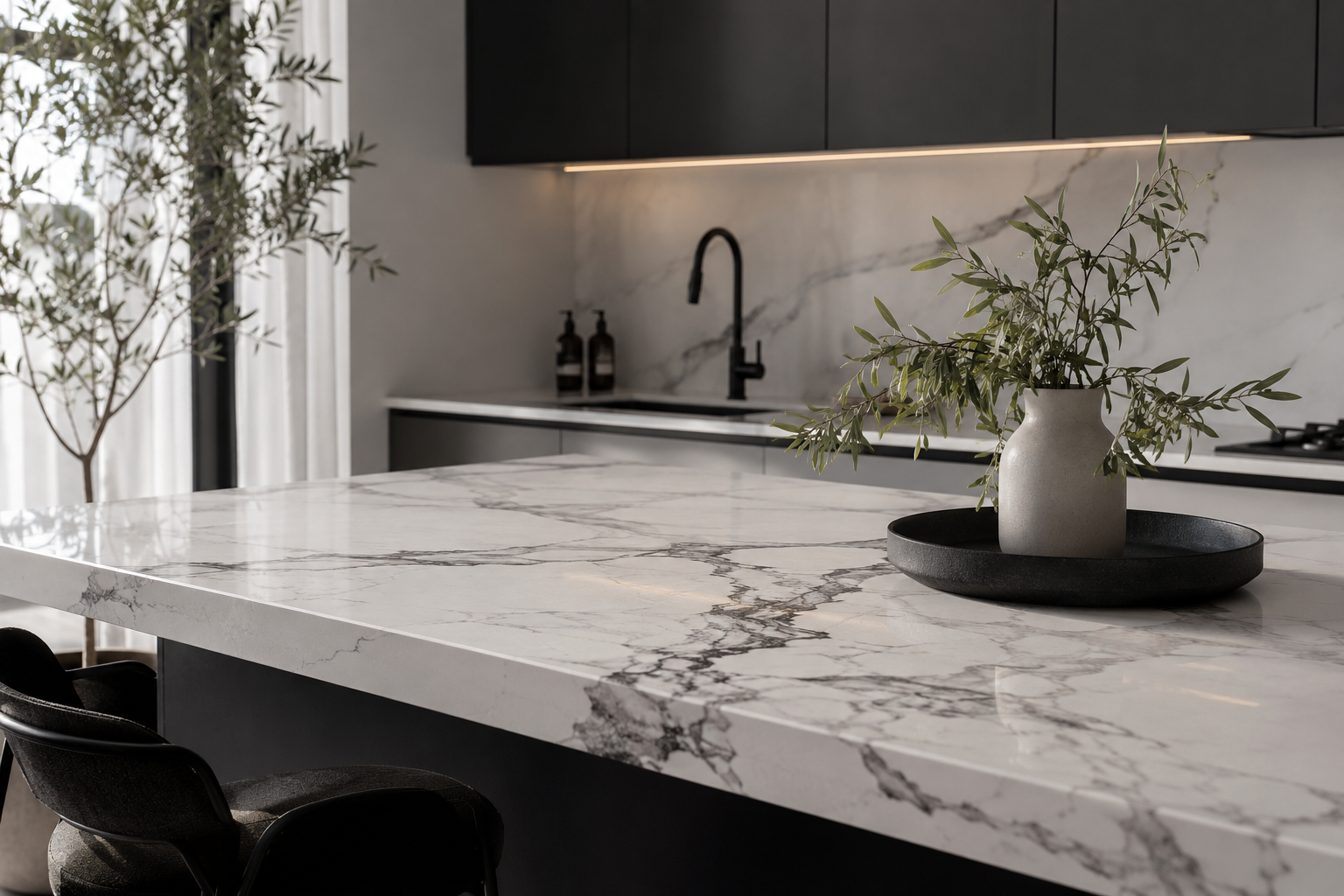
The surface has a lotus effect: drops of fat and liquid are not absorbed but roll off with the slightest tilt. Silver or copper ions, embedded in the structure at the nanolevel, suppress the growth of pathogens without any chemicals – this is valuable for families with small children and for professional kitchens.
The color palette ranges from arctic white to deep anthracite and warm terracotta. Japanese minimalism with its cult of perfect surfaces and absolute absence of excess – that's the aesthetic context in which nanoceramics looks most organic and convincing.
Light in Every Fragment: Recycled Glass Countertops
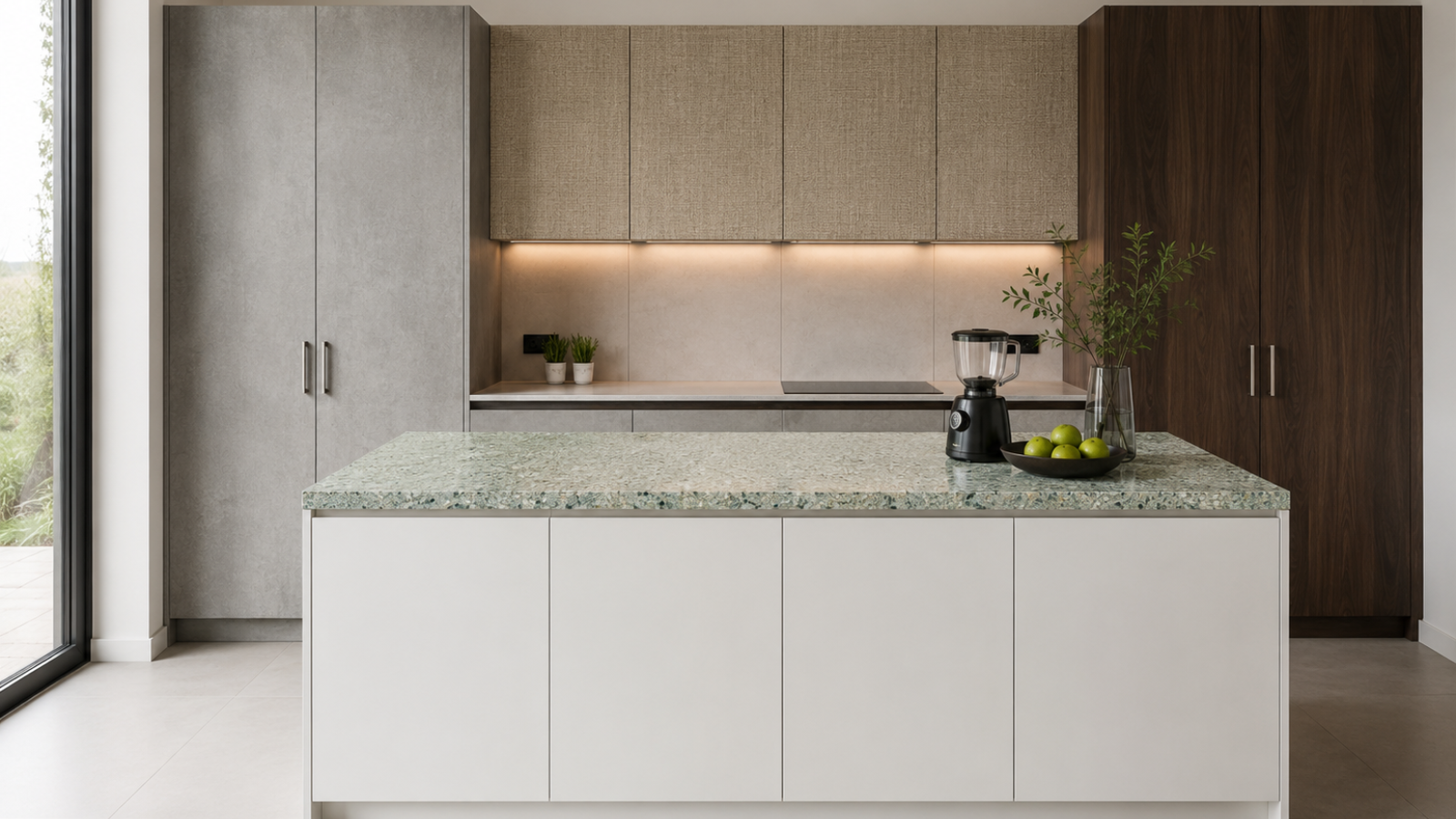
Recycled glass – one of the few materials that has no expiration date from an ecological standpoint: in the natural environment it decomposes in about a thousand years. Instead of broken bottles, windows, and industrial glass waste – elegant countertops made up of approximately 85% recycled material, bonded with cement or polymer binder.
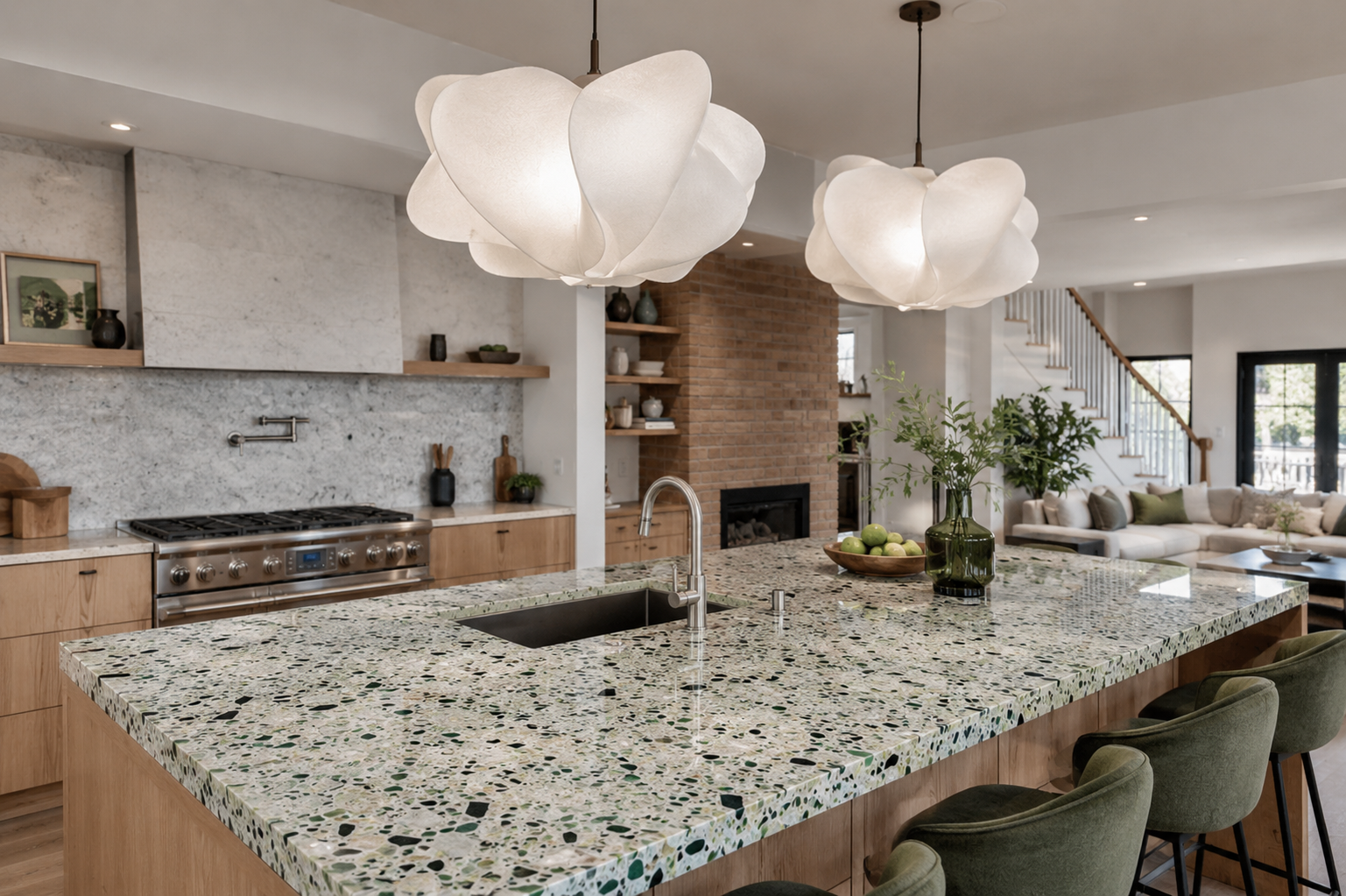
The main visual effect is a living mosaic depth of the surface that sparkles differently as the lighting changes. In 2025–2026, designers are working with contrast: glass surfaces are combined with stone, terracotta, or tiles – the combination of colors in the interior is built not on chromaticity, but on a dialogue of textures.
Wood with Ultra-Thin Coating: New Rules of the Game
Wood and kitchens – an eternal love story with eternal tension: moisture, grease, sharp temperature fluctuations. New technologies for applying ultra-thin polymer films change the rules. Natural veneer 0.6–1 mm thick is applied to an MDF base and sealed with a transparent film of 80 to 200 microns – so thin that the tactile sensation of living wood is completely preserved.
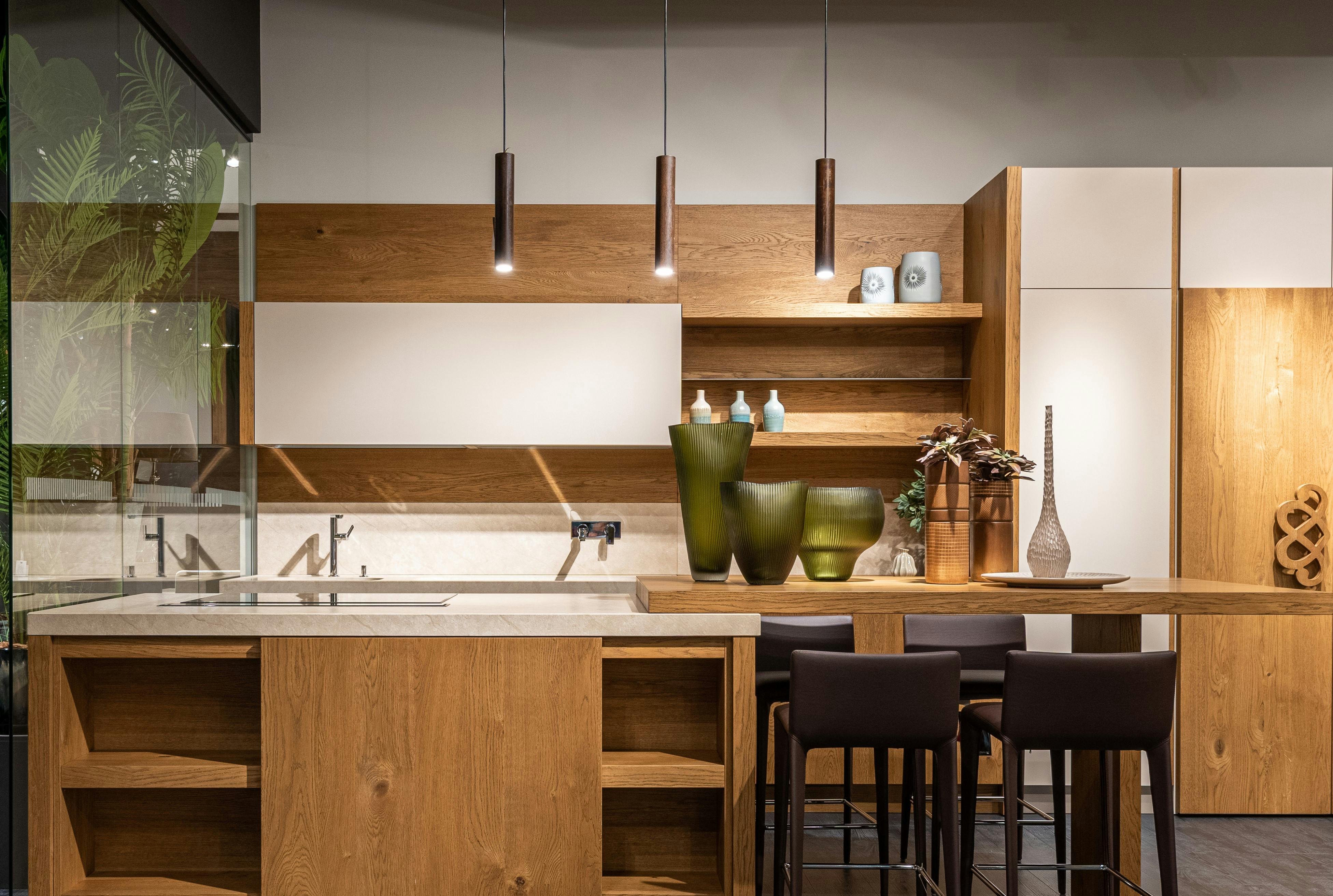
The phenolic base creates a hydro barrier: moisture doesn't deform or delaminate the panel even with prolonged exposure. Properly installed facades last 20 years and more. Built-in furniture with such facades looks monolithic, without the feeling of "glued" heterogeneous elements.
The development of new kitchen materials is not a compromise between beauty and eco-responsibility. It is proof that there is no longer any contradiction between them. And the best kitchen is one that will be pleasant to show guests even ten years from now.

No comments yet.